




For decades, the disposables industry efficiently solved a single problem: cost. Petroleum plastic was cheap, lightweight, moldable, and durable. The economic equation was perfect. The problem is that no one included in that equation the cost of what would happen next: 400 years of degradation, microplastics in the ocean, in the rain, in human blood.
Today, that deferred cost has come due. And the industry is urgently seeking materials that solve the problem at its source, not just at the end of the chain.
PolyAgave® is one of the most robust solutions available. And it's Mexican.
PolyAgave® is a line of bio-based bioplastic materials developed and patented by BioSolutions, a Mexican company founded in 2010. Its raw material is cellulose extracted from agave bagasse: the fibers left as a byproduct after the tequila industry extracts the plant's juice.
What makes this material technically relevant — and not just a good story — is its process. It's not about mixing plant fiber with conventional plastic and calling it "eco." PolyAgave® is a bioplastic formulated from scratch to work with existing industrial plastic manufacturing processes: injection molding, extrusion, and blow molding. This means that companies adopting it don't need to retool their machinery or change their production lines. The material adapts to the system, not the other way around.
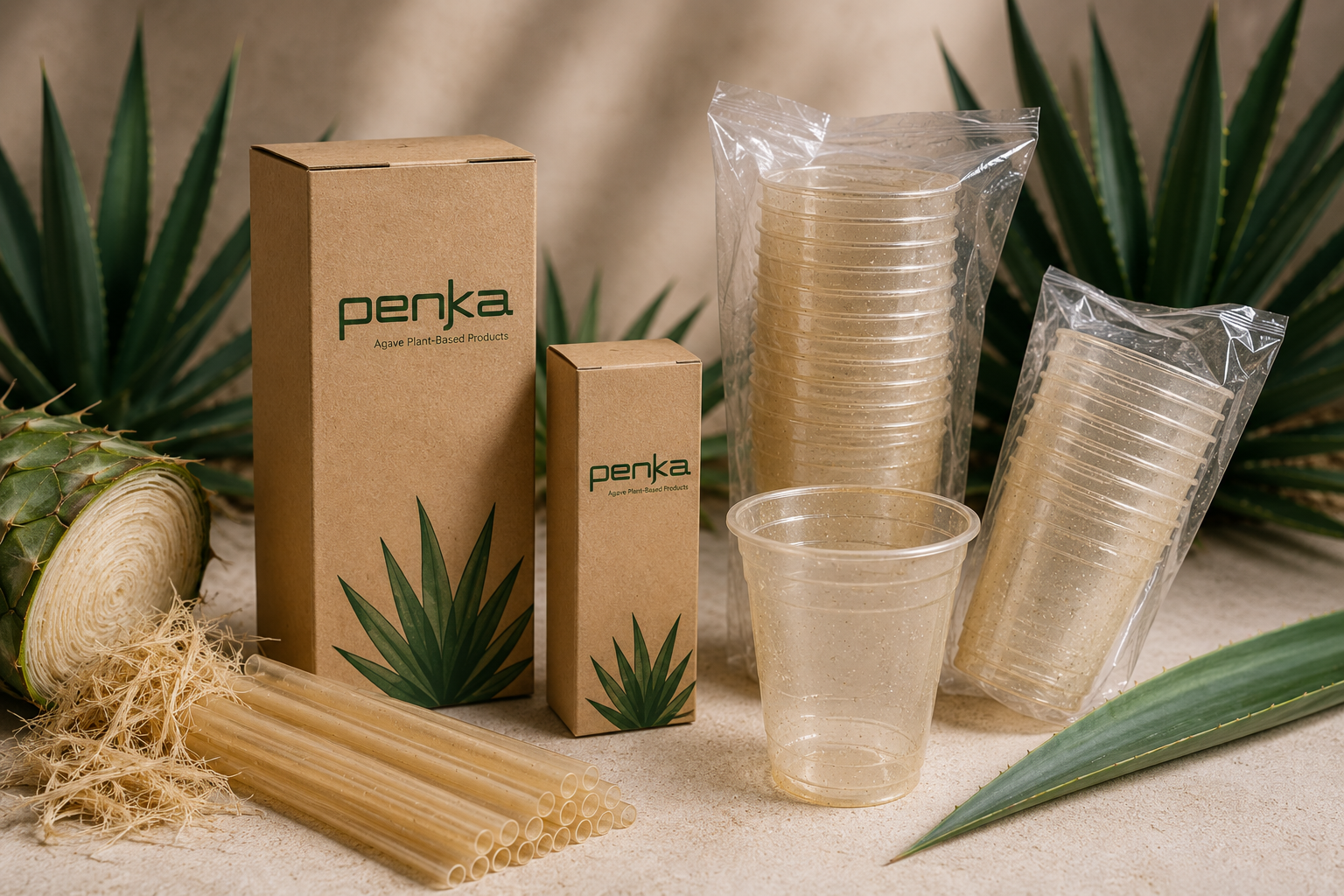
There are multiple grades and formulations of PolyAgave®, designed for various applications: from straws and cutlery to plates, cups, lids, cleaning products, decorative items, and refrigeration products. Today, it is used by national and international clients.
Not just any plant works for this. Agave has attributes that make it an exceptionally efficient raw material source:
It grows without irrigation water. Agave is a xerophytic plant: it survives and thrives solely on rainwater. This means its cultivation does not compete with the water resources needed by food agriculture — a critical factor in a country where water availability is a structural concern (CONAGUA, 2022).
It is an abundant industrial waste product. Mexico annually produces approximately 900,000 tons of agave bagasse as a byproduct of the tequila industry (Iñiguez-Covarrubias et al., 2001, Bioresource Technology). Before PolyAgave®, this bagasse was burned or accumulated without significant use. Today, it's the foundation of a biomaterial with a global market.
Does not displace food. Unlike other bioplastics that use corn starch or sugarcane —crops with direct food demand—, agave bagasse is an agro-industrial waste product. Its use does not create pressure on the food supply chain.
It has cultural and industrial depth. Blue agave has been integrated into Mexico's productive identity for centuries. The infrastructure for its cultivation, harvesting, and processing already exists on an industrial scale. PolyAgave® didn't create a new value chain; it leveraged an existing one.
Penka publishes verifiable impact data on its website per ton of product manufactured with its bioplastics. These are concrete figures, not aspirational estimates:
For every ton of Penka products manufactured with PolyAgave®:
(Penka, penka.eco/en/products)
These are not future commitments. They are results of the current production process, measurable and attributable to each ton of processed material.
In a market where greenwashing is a real risk for brands purchasing inputs, certifications are not an accessory. They are the difference between a promise and a guarantee.
PolyAgave® and Penka products feature:
FDA (Food and Drug Administration, USA): approved for direct food contact. The material that touches your drink or food meets the world's most stringent regulatory standard for food safety.
USDA Certified Biobased / BioPreferred: certification from the United States Department of Agriculture that verifies the biobased content of the material. It's not self-declaration: it's independent verification.
BPA and heavy metal free: verified. No bisphenol A, no metal contaminants in the food contact chain.
PNK Certification: our own distinctive mark for biobased products that guarantees the traceability and authenticity of the agave content.
Symphony Environmental: international certification related to controlled degradation technology.
Made in Mexico / Designed in Mexico: local manufacturing, with a supply chain anchored to the national territory.
Having one or two of these certifications is notable. Having all of them simultaneously is what makes PolyAgave® a compelling selling point for companies that need to safeguard their procurement decisions against sustainability audits, ESG reports, and increasing regulatory demands.
Penka manufactures and markets a complete line of PolyAgave® disposables that covers the main touchpoints in the food and beverage industry:
Straws: available in multiple formats — 21 cm and 26 cm individually paper-wrapped, jumbo versions for frappes, boba straws for tapioca drinks in 23 and 26 cm, and a 15 cm cocktail version. Black versions are also available for establishments with a premium aesthetic.
Stirrers: 18 cm in natural and black versions, for bars and cafes that require a product with a refined visual identity.
Cutlery: biodegradable fork, knife, and spoon individually, or in a 3-piece set with a napkin included — the ideal format for delivery service and events.
Biodegradable cups: 16 oz (510 ml) cup, the latest addition to the line, which extends the PolyAgave® offering to the container itself, not just the accessory.
The products' appearance is not generic. The plant content is visible: the translucent finish with agave content differentiates these products from a paper straw or a corn starch bioplastic. It's a visual differentiator that end-consumers perceive and that brands can communicate.
The business model behind PolyAgave® does not rely on creating new demand for agave. It relies on leveraging the byproduct of an industry that already operates on a massive scale.
The partnership between Penka and José Cuervo — the world's largest and oldest tequila producer — guarantees a constant and verifiable flow of agave bagasse as raw material. It's a circular supply chain that doesn't require crop expansion, doesn't create additional pressure on water resources, and transforms a waste product from a centuries-old industry into an input for an emerging industry.
For companies that purchase from Penka, this translates into a value proposition with a real story: their disposables are not just paper-based bio-products. They are connected to a value chain with a name, origin, and traceability.
The regulatory and market landscape is changing rapidly. The European Union already banned the most common single-use plastics as of 2021 (EU Directive 2019/904, European Parliament). In Mexico, state and municipal legislation is moving in the same direction. Companies that anticipate these changes arrive prepared; those that wait for legal obligation are late.
But beyond regulation, there's market pressure that data documents: 73% of global consumers state they are willing to change their consumption habits to reduce their environmental impact (Nielsen, 2018, Global Sustainability Report). For restaurants, hospitality chains, food companies, and retail brands, this isn't philosophy: it's purchasing preference. And purchasing preferences define revenue.
Adopting PolyAgave® is not an environmental responsibility expense. It's a competitive positioning decision with measurable returns in brand differentiation, proactive regulatory compliance, and access to a consumer segment with growing purchasing power and demands.
PolyAgave® is the first bioplastic developed and manufactured in Mexico from agro-industrial byproducts. That's a historical fact. But what makes it relevant in 2025 is not its origin, but its maturity: a patented material, certified by four independent organizations, compatible with existing industrial machinery, with a complete product line, and with a secured supply chain through an alliance with one of the largest companies in the Mexican agro-industrial sector.
The global bioplastics market is growing. Alternatives to conventional plastic are multiplying. In this context, what distinguishes a material is not the concept, but the execution. PolyAgave® delivers.


