




Both are presented as the "green" alternative to plastic, but which one truly delivers on its promise? We analyze durability, user experience, environmental impact, and cost to help you make the best decision.
When governments and brands began banning and replacing plastic straws, the industry reacted quickly. The paper straw was installed almost by default as the visible, accessible, and politically correct alternative. Establishments made the switch, customers accepted it with resignation, and the market assumed the problem was solved.
It wasn't.
Today, with more data on the table, the question many bar, restaurant, and hospitality chain operators are asking is not whether they should ditch plastic—that is already decided—but which alternative best fulfills its promise in real terms: durability, customer experience, verifiable environmental impact, and operating cost.
This analysis compares the two most prevalent materials in the Mexican and Latin American market: the paper straw and the agave straw. Four criteria. No initial biases. Just data.
This is the dimension where the difference between both materials is most obvious, most documented, and most relevant to daily operations.
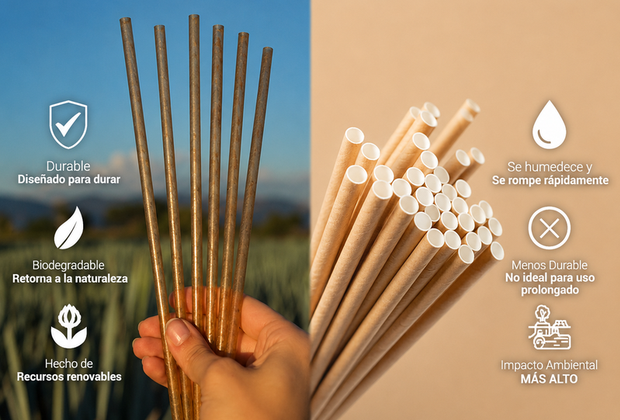
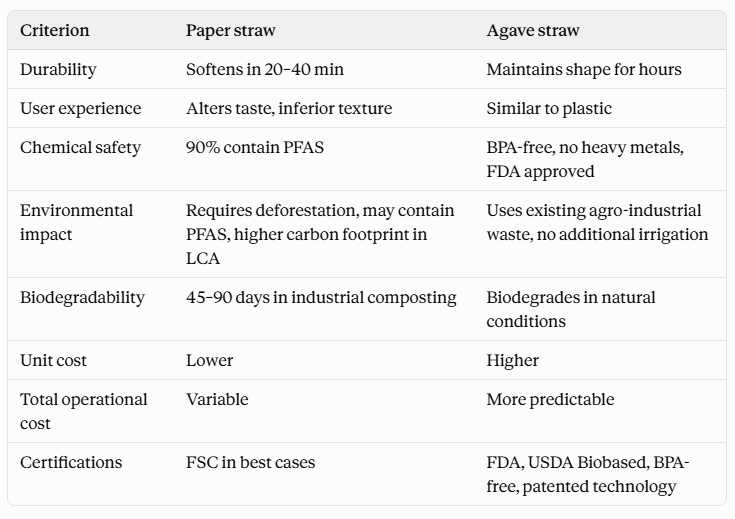
The paper straw has a structural problem that no manufacturer has been able to completely solve: it falls apart upon prolonged contact with liquids. In cold drinks with ice, deterioration begins between 20 and 40 minutes. In hot drinks, the process is even faster. The result is a straw that bends, loses rigidity, and in extreme cases, begins to disintegrate inside the customer's drink. The first generations of paper straws were widely criticized for exactly this reason, and although manufacturers have improved the formulation with coating layers, the underlying problem does not disappear: paper gets wet.
Agave straws exhibit remarkable durability in beverage service. Their natural resistance allows them to withstand prolonged exposure to liquids without compromising their structural integrity. Unlike paper straws, they do not soften or become soggy, even after hours of use.
Agave straws maintain their shape in hot and cold drinks, withstanding temperatures between -15°C and 40°C without disintegrating or affecting the flavor.
For a bar or restaurant, this is not just a matter of aesthetic preference. It is an operational issue: a straw that deteriorates forces the server to replace it, generates more waste per service, and produces an inferior customer experience that translates into measurable negative comments on social media and review platforms.
Winner in durability: agave straw.
The customer's experience with a straw is measured in seconds, but its impact on the perception of the establishment can last much longer.
The paper straw creates a user experience that consumers consistently describe as inferior to plastic: a different texture on the lips, a paper taste that can be perceived in delicate drinks—especially cocktails, fruit waters, or teas—and the visual discomfort of watching the straw progressively deteriorate in the glass.
Users describe the experience of using agave straws as very similar to plastic: "It feels like a slightly thicker plastic and doesn't fall apart in your drink." The texture is smooth and rigid, practically indistinguishable from a conventional straw.
From a practical perspective, agave straws offer an aesthetically distinct alternative to plastic. Their straight, uniform shape and natural finish enhance the overall presentation of drinks.
For establishments with a value proposition centered on the experience—cocktail bars, signature restaurants, boutique hotels—this factor is significant. The detail of the straw is part of the total customer experience, and a material that degrades that experience carries a cost that doesn't appear on the supplier's invoice, but does appear in Google reviews.
Hospitality experts highlight hard plant-based straws—PHA, sugarcane, agave—as crucial for a positive customer experience, as they approach the performance of traditional plastic.
Winner in user experience: agave straw.
This is the criterion where the conversation becomes more nuanced—and where the paper straw has the most unexpected problem.
The narrative of the paper straw as a green alternative has an implicit assumption: that it is made only of paper and that it biodegrades without consequences. Neither assumption is entirely true.
For a paper straw to withstand contact with liquids without immediately disintegrating, it needs a coating. And that is where a finding appeared that changed the debate in 2023.
A study published in the journal Food Additives and Contaminants concluded that "eco-friendly" paper straws contain long-lasting and potentially toxic chemicals. PFAS—per- and polyfluoroalkyl substances, known as "forever chemicals"—were found in the majority of the straws analyzed, and were more common in those made from paper and bamboo.
PFAS were found in 90% of the paper straws analyzed. The most common PFAS found was perfluorooctanoic acid (PFOA), which has been banned globally since 2020. Trifluoroacetic acid (TFA) and trifluoromethanesulfonic acid (TFMS) were also detected. These "ultra-short chain" PFAS are highly water-soluble and could leach from the straws into drinks.
PFAS can remain in the body for many years and their concentrations can accumulate over time.
This does not make the paper straw an immediately dangerous product, but it does dismantle its main selling point: it is not necessarily safer or cleaner than the alternatives it aims to replace.
There is a second structural problem: paper is not always a resource without environmental cost. Its production requires tree felling, significant volumes of water, and chemical bleaching processes. Life cycle assessment studies show that paper straws can have up to 2.5 times the climate impact of conventional plastic straws. This is not to say that plastic is better—it has other much more serious long-term costs—but rather that the paper straw is not the simple solution its narrative suggests.
The agave straw starts from a radically different logic: it leverages a byproduct that already exists and would otherwise be waste.
Agave fiber is obtained as an agro-industrial residue after tequila production, in a region that generates more than 350,000 tons of agave waste per year. Unlike bamboo—imported from Asia—or wheat straw—which competes with animal feed—agave residue has no alternative use. The primary purpose of agave is to produce tequila and mezcal; what remains is massive waste that, when turned into straws, is a form of upcycling that creates no additional pressure on any other resource.
The quantified impact figures that Penka publishes per ton of product manufactured with PolyAgave® are concrete: more than 3,000 kg of agave byproducts are reused, the consumption of nearly 150 liters of oil is reduced, and the emission of 450 kg of CO₂ into the environment is avoided. (Penka, penka.eco/en/products).
Additionally, agave is a xerophytic plant: the agave material developed by Mexican companies reduces the carbon and water footprint, as agave requires rainwater rather than intensive irrigation. In a country with increasing water stress, that is no minor detail.
Winner in real environmental impact: agave straw, with the clarification that paper straws have advantages in biodegradability in specific contexts—industrial composting—but their PFAS issues and full life cycle make them a less clean choice than their marketing suggests.
This is the criterion where the paper straw has its clearest advantage: unit price. A paper straw is, generally speaking, cheaper than one made of agave or plant-based bioplastic.
However, unit cost is not the actual operating cost. To calculate it correctly, three variables that are frequently omitted must be included:
Replacement rate per service. A paper straw that deteriorates in 30 minutes in an iced drink generates more replacements per service than an agave one that lasts all night. In high-volume establishments, that difference in the replacement rate can significantly reduce the unit cost advantage of paper.
Customer experience cost. A customer who receives a deteriorated straw at a premium establishment perceives an inconsistency between the price they pay and the quality they receive. That impact on the perception of value is difficult to quantify but is real, and it translates into a lower propensity to return and recommend.
Future regulatory cost. Regulations on single-use plastics—and on materials with PFAS—are advancing globally. In industrial composting environments, paper biodegrades in 45 to 90 days, a significant improvement over plastic. But if regulations on PFAS in food-contact materials tighten—a trend already observed in Europe—the paper straw could face additional restrictions that force a new change of supplier, with all the costs that entails.
In pure unit cost: paper straw. In total operating cost considering all variables: the gap narrows considerably, and in premium establishments, agave can prove more efficient.
For a high-volume establishment with tight margins and a basic value proposition, the paper straw may remain a viable short-term option, especially if drink consumption time is short and the value proposition is not centered on a premium experience.
For any establishment that competes on experience—a cocktail bar, a signature restaurant, a boutique hotel, a chain with documented ESG commitments, or a brand that builds a narrative around sustainability—the analysis points clearly toward agave.
The reason is not just environmental. It is that the paper straw solves an image problem—"we moved away from plastic"—without solving the underlying issue. The agave straw solves both: it eliminates conventional plastic AND offers a user experience, an origin story, and certifications that paper cannot match.
For Mexican brands in particular, there is an additional dimension that data doesn't capture but the market certainly values: a straw made from Mexican agave, in partnership with the national tequila industry and certified with technology patented in Mexico, tells a story that connects directly to the identity of what many establishments serve in their glasses.
That doesn't have a unit price. But it does have brand value.
Ready to evaluate the change in your operation? Discover Penka's full line of agave straws and disposables at https://penka.eco/en/products.
Learn more about our straws made from agave.


